
Austin Deck Builders for the Whole Deck's Life
Deck builders in Austin, TX should know this city’s ground, houses and sun before they quote your yard. We’ve built, stained and repaired decks here since 2013, from east side clay to west side limestone, and we stay for the deck’s whole life.
Request Free Quote


A Deck Company Shaped by This City
Austin isn’t one building environment; it’s several wearing the same zip codes, and a deck crew that treats Tarrytown, Mueller and Circle C as the same job hasn’t been paying attention. We have been, since 2013. Request an estimate and the visit starts from what your part of town is actually working with: the soil, the housing era, the trees and the sun angle your street lives under.
That local reading isn’t a flourish. It decides footing depth, material recommendation, finish schedule and sometimes the whole design, and it’s why the same company that answers the phone also does the digging. Nothing about your deck gets decided by someone who’s never stood in your yard. It’s also why the recommendations survive scrutiny: every one traces to something observable about your specific lot, and we’ll point at it while we explain.
Hiring inside the city buys you something specific: a crew whose working assumptions were formed on these exact blocks. We know which neighborhoods hide sprinkler mains where teardowns want to dig, how the afternoon sun works a west-facing yard off Loop 360 versus a shaded lot under old-growth pecans in Cherrywood, and what the difference means for every recommendation we make. Out-of-town crews learn your city on your invoice. We already paid that tuition.
East Side Clay, West Side Limestone
Cross MoPac heading west and the ground changes underneath you: the Hill Country’s limestone starts shelving near the surface, which changes how footings get dug and sometimes what they cost, while giving hillside lots the grades that make layered decks worth building. Head east and you’re on blackland prairie clay, ground that swells with rain and shrinks in drought, moving whatever was built shallow on top of it.
Neither soil is a problem; both are just facts that a deck’s foundation has to respect. West-side projects get footings planned around rock and slope, and a multi-level deck conversation when the grade earns it. East-side builds get depth and design that ride out clay movement instead of cracking against it. A deck that ignores which Austin it’s standing in is a deck that ages fast, and we’ve repaired plenty of those. We’ve dug both sides of that line for over a decade, and the scopes price each honestly: rock work where rock lives, depth where the clay demands it, and never a one-size footing spec pretending the city’s one place.
Water deserves its own line in this town. Central Texas rain arrives in bursts, the creeks run hard when it does, and yards near the greenbelts and drainage corridors move a lot of water fast. Deck design here accounts for where that water goes: footings placed out of the wash, ventilation that dries a low frame quickly, and grading conversations that happen at the estimate rather than after the first spring storm. It’s unglamorous, and it’s the difference between a deck that shrugs off an Austin downpour and one that soaks in it.

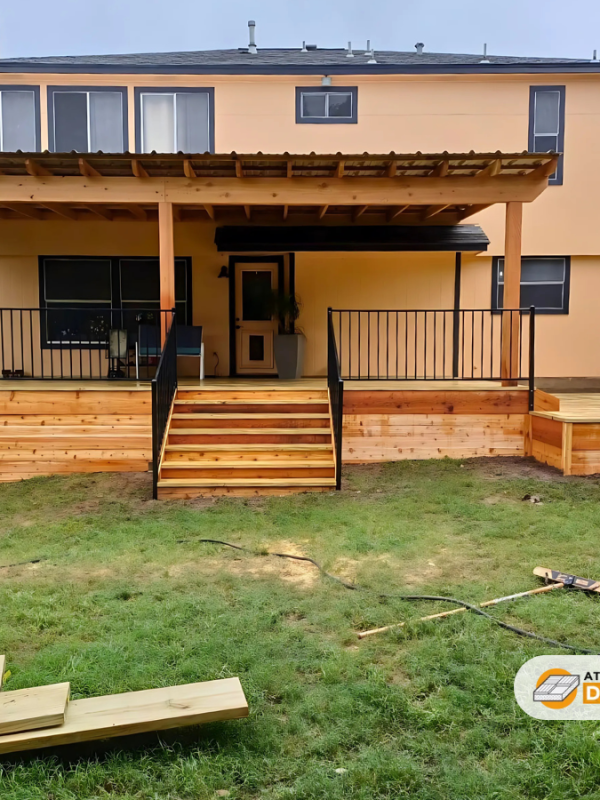
Decks for Every Era of Austin House
This city’s housing stock runs from 1930s bungalows through 1970s ranches to subdivisions that didn’t exist five years ago, and each era hands its deck a different starting point. Older central neighborhoods often have decks on their second or third owner, built to standards that have since moved on, where a deck inspection tells you honestly what you inherited and a deck repair or replacement call follows the framing, not the paint. We’ve stood under enough of this city’s older decks to know the difference between charming vintage and quiet hazard, and the report always says which.
Newer builds come with builder-grade decks that were priced to close a sale, not to host a decade of dinners, and upgrading them is some of our most common Austin work. And infill lots, where a new house landed on an old street, tend to want space-efficient designs that make a compact yard live large. Same city, three different briefs, and we’ve built for all of them. The upgrade conversation always starts from what the builder deck taught you: where the sun lands, where the traffic runs, and what the household actually does out there when nobody’s staging a photo.
The newest chapter is the infill and ADU era: second units, garage conversions and backyard offices reshaping central lots, with decks doing the connective work between structures. Those projects reward tight design, since every square foot of a central Austin yard is spoken for twice, and they’re where our compact-layout thinking gets its best workouts.
Everything the Deck Needs, One Crew
The full menu lives here. New deck installation designed for your lot rather than adapted from a template, whether the material talk lands on wood for feel and budget or somewhere with less upkeep.
Composite decking carries the low-maintenance side of that conversation, and deck staining runs on the schedule your exposure sets, which in this sun is the difference between a finish and a memory of one. The maintenance side of the operation keeps the whole city’s finish clocks straight: the same UV that fades an east side fence in three summers is working on every unshaded deck in town.
And when a deck’s past saving, deck replacement handles the honest teardown and a rebuild on footings done right. The point of the one-crew structure is simple: your deck’s history stays in one place, and the people who set its posts are the people reading its condition in year six.
Trees, Permits and Austin's Particulars
Building in Austin comes with Austin’s rules. The city takes its protected trees seriously, and a deck design here often starts by respecting a root zone that a design anywhere else would ignore; we treat the tree as a feature and plan around it, which usually improves the deck anyway. Where projects need city approval, our trusted third-party partners handle the permit process, and the differences between Austin proper and the metro’s smaller cities stay our homework, not yours. The tree conversation usually surprises people pleasantly: what looked like an obstacle becomes the shade plan, and the deck ends up where the yard wanted it anyway.
Scheduling is the everyday advantage of hiring inside the city: we’re already here, working central neighborhoods every week, so estimate visits book quickly and small jobs don’t wait behind a commute. You can see the range of Austin work in recent deck projects, from compact east side builds to west side hillsides.
Season-wise, Austin gives deck work a long runway: fall through spring is prime building weather, summer builds just get sequenced around the heat, and staining season is effectively year-round with the right dry windows. Whatever month you’re reading this, the honest answer to ‘is now a good time’ is usually yes, with the details handled in scheduling rather than excuses.

Frequently Asked Questions
How do I choose between deck builders in Austin?
Compare written scopes, not phone quotes. When you line up what deck builders Austin TX searches surface, the separator is paperwork: footings specified, hardware named, exclusions stated, change handling explained. A builder who documents those before you sign will build the same way. One who won’t, won’t.
Do you build decks all over Austin?
Yes, central neighborhoods to the edges: east side, south Austin, the western hills and everything between. The soil, lots and housing stock differ block to block, and the designs follow suit. If you’re inside the metro, you’re in range, and the estimate visit confirms it same-week in most seasons.
Do I need a permit for a deck in Austin?
Often, depending on height, size and attachment to the house, and Austin’s requirements differ from the suburbs around it. You don’t need to decode any of that: where approval applies, our trusted third-party partners run the process, and the deck gets built to what the approval requires.
What about Austin's protected trees?
The city protects its larger trees, and decks near them get designed with root zones in mind from the first sketch. In practice that’s rarely a limitation; a design that honors a mature oak usually ends up better than the one that fought it, with shade exactly where an Austin deck wants it.
What deck material works best in Austin?
Depends which Austin you’re in. Full-sun exposures push toward composite, since our UV sets the fastest staining clocks in the state. Shaded lots keep wood’s whole case alive. West side hillsides often mix materials by level. The estimate visit answers it for your yard, with samples in your actual light.
Do you handle old decks on older Austin homes?
Constantly, and they’re some of our favorite work. Central Austin’s older neighborhoods hold decks with real history and unknown framing, so we start with an honest structural read, then repair, resurface or replace based on what the wood says. Plenty pass with small fixes; the point is knowing, not guessing.
Closing
If you’ve been comparing deck builders in Austin, the fastest way to sort us from the pack is one visit. Reach our team or call 512-900-6030 and put us in your yard.
