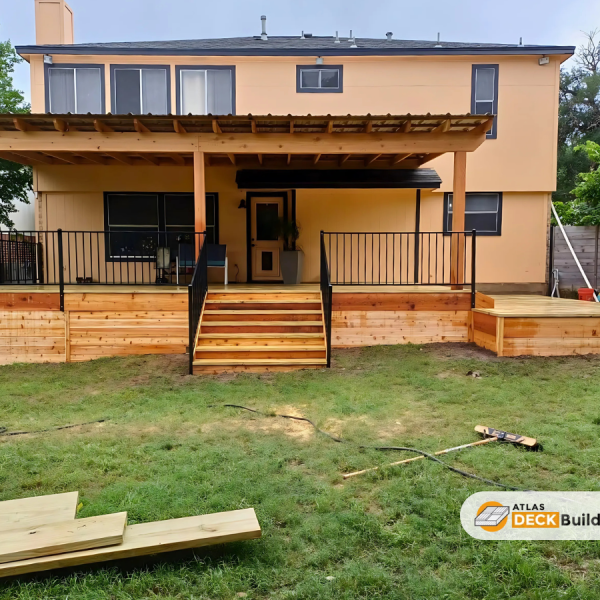
Deck Installation for Austin Backyards
Deck installation in Austin starts with the lot, not the lumber. We design and build wood and composite decks around your yard’s sun, slope and soil, handle the details that keep a frame square for decades, and walk you through every decision.
Request Free Quote


The Decisions That Shape a Deck
Before anyone prices a board, three questions decide most of the project: how you’ll actually use the space, where the sun sits in July, and what the ground is doing under your feet. We start every job there. Request a deck estimate and the first visit is exactly that conversation, on your lot, looking at your yard instead of a brochure.
Use decides more than square footage does. A deck for a grill and two chairs wants different traffic flow than one that hosts twenty people in October, and a deck you’ll read on at 8 AM wants different orientation than one for summer evenings. We’d rather ask these questions before the design than watch you rearrange furniture around the answer for ten years. The sun question matters just as much: a west-facing deck without shade planning is a beautiful space you’ll use three months a year, and solving that is a design problem, not a furniture problem.
Materials We Build With
Wood decks are still the Austin default for good reasons: they cost less up front, they can be refinished instead of replaced when the surface ages, and nothing else feels quite like real wood underfoot. Pressure-treated pine does the structural work on almost every deck we build; for the boards you walk on, the conversation is usually treated pine for budget or cedar for looks and natural weather resistance. The trade is a finish schedule, because Texas sun asks wood to be protected on a real interval.
Composite decking flips that trade. It costs more on day one and then mostly leaves you alone: no staining cycle, no splinters, color that holds for years instead of seasons. The honest fine print is that composite runs hotter underfoot in full sun and still wants an occasional wash and hardware check. It’s not maintenance-free. It’s maintenance-light.
Which one is right comes down to shade, budget shape and your appetite for upkeep. Heavy afternoon sun pushes toward composite, because it skips the refinishing cycle UV accelerates. Love of the real thing and a willingness to stain on schedule keeps wood firmly in the running. We’ll walk both against your actual yard, with the reasoning attached, and you make the call.
A note on what we won’t do: we don’t push the material with the better margin, and we don’t quote a species or a board line we wouldn’t stand behind in this climate. If a product’s main virtue is the brochure, you’ll hear that from us in plainer words.


Deck Types We Build
Single-level decks are the workhorses, and they’re less simple than they look. Low builds need real attention to drainage and airflow underneath, because a deck hovering a foot off damp ground without ventilation is a rot timeline, not a patio. We frame low decks so air moves and water leaves.
Sloped lots are where design earns its keep: a multi-level deck turns a grade change into separate spaces for cooking, sitting and stairs down to the yard, and it’s often the reason the best view on the property finally gets used.
We also build rooftop decks where the structure allows it, and pool decks where surface temperature and slip resistance drive the material call. Raised and poolside projects get engineered conservatively, because a deck you second-guess isn’t worth owning.
One more early fork: attached or freestanding. Attaching to the house saves posts but makes the ledger connection the most important dozen fasteners on the whole build, flashed and bolted so water and weight both go where they should. Freestanding costs a little more framing and forgives a lot more. Your house’s construction usually makes this decision for us, and we’ll explain why yours points the way it does.
How an Installation Runs
The sequence doesn’t change much job to job, and that’s on purpose. Site visit and measurements first. Then a design and a written scope, so you know what you’re agreeing to. Where the project needs city approval, our trusted third-party partners handle the permit legwork so it doesn’t land on you. Then the build: footings sized for the soil, framing checked square before a single deck board goes on, fasteners chosen for movement in heat swings.
The details you’ll never see are the ones we’re pickiest about. Footings poured to depth for the soil on your lot, not a one-size spec. Flashing where the deck meets the house, because that joint is where decks fail first. Joists protected at the tops, where trapped water starts rot years early. Hardware rated for outdoor structural use rather than whatever’s cheapest by the box. None of it shows in photos, and all of it is why a deck feels the same in year twelve as it did at the walkthrough.
The last step is a walkthrough with you on the finished deck. We’d rather hear about a concern while the trailer’s still in the driveway than in a review three weeks later. That’s how we’ve kept working across Austin since 2013, mostly on referrals from earlier builds.
On timing: most residential builds run one to three weeks on site once materials arrive, with the design and approval stretch before that varying more than the build itself. You get a schedule with the written scope, and if weather or a supplier moves it, you hear about it from us first, not from an empty driveway.
Built to Be Maintained
Every deck is a maintenance decision as much as a construction one, and we bring that up before you pick a single material. A west-facing wood deck will want deck staining on a real schedule. Any deck benefits from an occasional deck inspection once it’s a few years old. We build with that future in mind, and we’re the same crew you can call when it arrives.
That’s also why we’re careful about board gapping at install. Boards go on at different spacing depending on their moisture content and the season, because a gap that’s right in a wet spring closes up wrong by August. It’s a small decision with a decade of consequences for drainage and finish life.
What Drives the Price
Size matters less than people expect. What moves the number: elevation and railing length, material tier, site access, and how much the ground makes us work for level footings. The estimate visit puts a real figure on your specific lot, and you can look through recent deck projects to see what different scopes look like when they’re done.
If budget is the open question, say so early. There’s almost always a version of the project that fits: phasing a large build, simplifying the railing run, or choosing a material tier that trades some finish for a lot of frame. We’d rather design to your number than show you something you won’t build.

Frequently Asked Questions
How long does deck installation take in Austin?
Most residential builds run one to three weeks on site once materials arrive, depending on size, elevation and weather. The design and approval stretch before that varies more than the build itself. We give you a schedule with the written scope, and we tell you early if something moves it.
Do I need a permit to build a deck in Austin?
It depends on the deck’s height, size and attachment to the house, and the rules differ between Austin proper and the surrounding cities. You don’t need to untangle that yourself. Where approval is required, our trusted third-party partners handle the process, and we build to what the approval requires.
Should I choose wood or composite?
Shade and patience decide it more than looks do. Heavy sun exposure favors composite, because it skips the refinishing cycle that Texas UV accelerates. If you like the feel and price of wood and don’t mind a staining schedule, wood remains a great deck. We’ll walk both options against your actual yard.
Can you build a deck on a sloped yard?
Yes, and sloped lots are some of our favorite work. The usual answer is a multi-level design with footings stepped down the grade, which costs more than a flat build but turns unusable ground into the best part of the property. The estimate visit tells you what your slope needs.
Do you install decks in the summer?
We build year-round. Summer installs just get planned differently: earlier crew hours, attention to how fasteners and boards behave in heat, and finish work scheduled so nothing cures in triple-digit afternoons. If a step would suffer in the conditions, we sequence around it rather than push through it.
What makes deck installation in Austin different from other places?
The climate does. Long UV exposure fades and dries finishes, sudden storms test drainage and flashing, and clay-heavy soils move with moisture swings, which is why footing depth and framing details matter more here than in gentler climates. A deck built to generic specs ages fast in Central Texas.
Do you replace old decks too, or only build new ones?
Both. If your existing deck is past saving, we handle the tear-out and haul-off as part of the project, and the new build starts on footings we’d stand behind rather than whatever was there before. If you’re not sure the old deck is actually done, we’ll assess it honestly first, because sometimes it isn’t.
Closing
If a deck’s been on the list for a while, start with the conversation. Reach our team or call 512-900-6030 and tell us about your yard. We’ll tell you honestly what it takes to build it right.