
Round Rock Deck Builders for Every Backyard
Deck builders in Round Rock, TX are increasingly doing two jobs at once: building new decks for a city still growing, and rescuing the boom-era decks now aging past their builder-grade beginnings. We do both, and we’ll tell you honestly which job yours is.
Request Free Quote


Round Rock's Decks Are Coming of Age
Round Rock grew fast through the nineties and two-thousands, and the decks went up with the subdivisions: thousands of them, mostly builder-grade, mostly treated pine, mostly built to the minimum that closed the sale. Those decks are now fifteen to thirty years old, and they’re aging on schedule. Fasteners backing out, posts soft at the soil line, boards past their last finish. If that sounds like your backyard, request an estimate and we’ll tell you where your deck sits on its curve.
The honest range of answers is wide. Plenty of boom-era decks want a deck repair and a finish schedule, and they’ll serve another decade. Some have reached the point where repairs become a subscription, and deck replacement on proper footings is the cheaper decade. The diagnosis comes with photos and the math, and the decision stays yours. Round Rock decks earned their retirement honestly; the question is only whether yours has reached it, and that’s a framing question, not a feelings question.
If you want the quick self-check before we visit: push sideways on a rail post, look at where the posts meet the ground, and glance under the deck at the board tops of the joists. Movement at the rail base, softness or staining at the post feet, or dark lines along the joist tops are the boom-era deck’s three most common confessions, and any one of them is worth a professional look while the fix is still small. It takes five minutes, costs nothing, and it’s the same walk we’d do first anyway.
Built on Blackland, Built for It
Most of Round Rock sits on blackland prairie clay, and clay is the quiet author of half the deck problems we see here. It swells with the spring rains and shrinks through the summer drought, and a deck footed shallow rides that movement year after year until posts lean and frames rack. It’s why a Round Rock deck’s most important specification is one nobody photographs: how deep and how well its footings were set. The clay writes slowly, but it never stops writing, and every Round Rock deck’s story includes it.
New builds get footings designed for that movement from the start. Older decks get their foundations read honestly during any deck inspection, because a boom-era deck’s future is usually decided below the grass line, not above it. Either way, the clay isn’t a problem. Building like it isn’t there is the problem. We move downspouts, extend discharge lines and reroute splash as part of repair scopes whenever the water map calls for it, because fixing the post without fixing the water is a subscription we don’t sell. The footing that stays dry is the footing that stays.
Flat lots add a quieter water problem: with little natural grade to carry runoff away, roof and gutter discharge tends to linger exactly where deck posts live. Half the soft post bases we find in Round Rock trace back to a downspout aimed at the deck’s foundation for a decade. It’s a five-dollar diagnosis with a big payoff, and we check for it on every visit here.

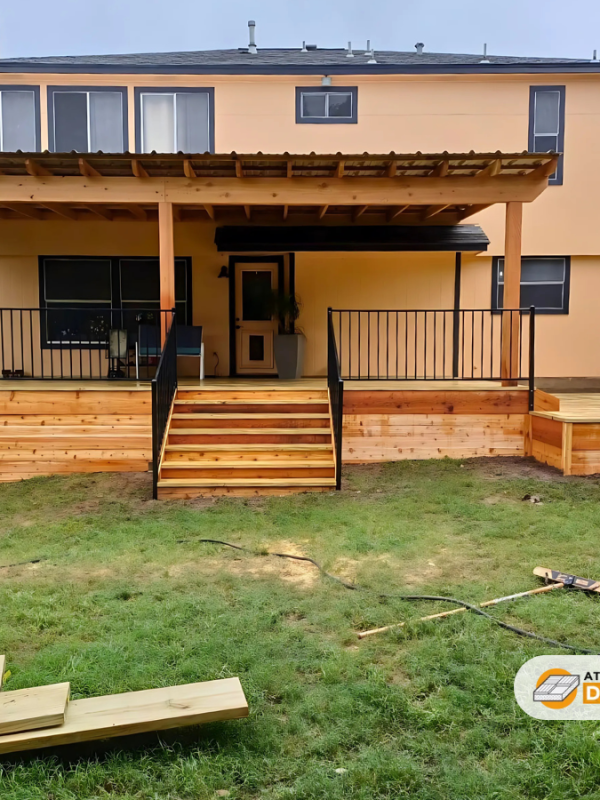
New Decks for Full Households
The other half of our Round Rock work is new construction for a city of busy, growing households, and the briefs have a family shape to them: room for a long table, grill territory out of the traffic lane, and surfaces that survive cleats, wagons and dogs. Deck installation here leans practical, and composite decking earns its premium often, because a household running at full speed rarely votes for a staining schedule. Layout-wise, the flat lots here are a gift: without a grade to negotiate, the budget goes into surface, shade and size instead of footholds, and the designs stretch further per dollar than they do in the hills.
Wood still wins plenty of Round Rock yards on budget and feel, especially shaded ones, and when it does we put the finish plan in writing on day one. Whichever way the material conversation goes, it happens with samples in your yard and the reasoning attached. Either way the finish plan goes in the scope on day one, sized to the shade your lot actually has today rather than the shade the sales brochure promised.
Shade is the other thing boom-era subdivisions are still growing: the trees went in with the houses, and many are only now reaching the size that throws real afternoon cover. Until they do, Round Rock decks live in more direct sun than older-neighborhood decks ever face, which shortens wood finish intervals and strengthens composite’s case. We factor the shade you’ll have in five years into the material talk, because the trees are coming, just on their own schedule.
HOA Reviews, Handled Calmly
Most Round Rock neighborhoods come with an HOA, and most HOAs want a look at exterior projects before they start. That’s a paperwork rhythm we work with weekly: the written scope gives your review board what it asks for, design constraints get accommodated without drama, and the timeline accounts for the approval window instead of being surprised by it. Mention the HOA when you book and it’s planned for from the first sketch. Boards that ask for material samples get them attached digitally with the scope, which shortens most reviews by a cycle.
City-side approvals run the same way: where a permit applies, our trusted third-party partners handle the process, and Round Rock’s requirements stay our homework rather than yours. The approvals never become your homework in either building.
On timelines: most repair scopes here finish in a day or two, new builds run one to three weeks on site once materials arrive, and the HOA window sits in front of whichever applies. The written scope carries your actual dates, and schedule changes come from us before you notice them, which is a small promise that turns out to be rare in this trade.
Close Enough to Be Your Regular Crew
Round Rock isn’t an occasional destination for us; it’s a standing part of the week, with deck staining routes and repair calls keeping us in the neighborhoods between the big builds. That matters for the small stuff: a crew that’s already nearby returns calls about one wobbly rail, and a staining schedule actually gets kept when the truck passes your exit anyway. That neighborhood rhythm is also how boom-era decks get caught early: half our Round Rock repair calls start as a question asked while we’re staining next door.
The work runs the same standard whether the address is Round Rock or central Austin, and recent deck projects shows both: new family workhorses and boom-era rescues, side by side, weathering the same Texas seasons. Same crew, same standard, shorter drive.

Frequently Asked Questions
Do deck builders in Round Rock handle repairs, or only new builds?
We do both, on purpose, because Round Rock’s deck population needs both: a wave of boom-era decks aging into repair decisions, and a growing city still building new. The diagnosis visit sorts which conversation your deck needs, with photos of the framing and the honest math for each path.
My builder-grade deck is 20 years old. Repair or replace?
The framing and footings decide, not the age alone. Sound structure with tired surfaces points to repair and refinishing; soft posts, moved footings or spreading rot point to replacement, because fixing those piecemeal costs more across three years than rebuilding once. You get photos and both prices, then you choose.
Does Round Rock's clay soil really affect decks?
More than any other local factor. Blackland clay swells and shrinks with the moisture cycle, and shallow-footed decks ride that movement until posts lean and frames loosen. Proper footing depth neutralizes it, which is why our Round Rock builds and inspections start with what’s happening below the grass.
Will you work with my HOA?
Weekly, and it’s routine rather than a hurdle. The written scope covers what review boards ask for, design requirements get folded in from the first sketch, and the project timeline includes the approval window. Tell us the HOA exists when you book, and the rest of the paperwork rhythm is ours.
How fast can you get to Round Rock?
We’re in Round Rock most weeks already, between builds, staining routes and repair calls, so estimate visits book quickly rather than waiting on a special trip. Storm-damage looks get priority after weather events. Call during business hours and you’ll get a real date before you hang up.
What deck material do Round Rock homeowners usually pick?
Composite wins many of the full-sun, full-speed households here, since it skips the staining clock our UV runs fast. Wood keeps winning on budget and on shaded lots. Boom-era replacements often upgrade to composite while reusing the lesson of the old deck’s layout. Samples in your yard settle it.
Closing
Whether your Round Rock deck needs building, saving or just a straight answer, one visit sorts it. Reach our team or call 512-900-6030.
