
Deck Builders Serving Cedar Park Homes
Deck builders in Cedar Park, TX mostly meet the same deck: the modest builder-grade original that came with the house, now outgrown by the household on it. We upgrade, expand and replace those decks, and build the custom ones people wish they’d started with.
Request Free Quote


Cedar Park Grew Fast. Its Decks Are Catching Up.
Cedar Park went from small town to full city inside two decades, and most of its housing arrived in that rush: neighborhoods of newer homes, each with the compact builder deck that came standard. Those decks did their starter job. Now the households on them have grown into bigger tables, more birthdays and backyards that carry more of the family’s life, and the eight-by-ten original is visibly outmatched. Request an estimate if that’s your backyard; outgrowing a deck is the best problem a deck can have. We’ve replaced enough eight-by-tens here to recognize the pattern from the driveway.
The upgrade takes several shapes and we price them honestly against each other. Sometimes the original frame supports a real expansion. Often the smarter money starts fresh with a deck installation designed for how the household actually lives now, using the original’s lessons about sun and traffic. The estimate visit reads the existing structure and lays the versions side by side. Either way, nothing gets ordered until the versions sat side by side.
The outgrown-deck symptoms are consistent: the table that no longer fits the birthday, the grill exiled to the lawn, chairs migrating onto grass because the deck ran out, and a household that stopped using the space because using it felt like queueing. None of that is a structural failure. All of it is a design brief writing itself, and it’s a far better starting point than a blank yard, because the old deck already ran the experiments.
The Limestone Under the Lawn
Cedar Park sits where the Hill Country’s limestone starts asserting itself, and plenty of local lots hide rock a shovel’s depth under the grass. That changes footing work: sometimes it means harder digging, sometimes it means anchoring to stone that will never move, and either way it’s a site condition worth knowing before a price gets promised. It’s one more reason we don’t quote from photos; the ground here doesn’t photograph. Neighbors two streets apart can be digging different planets here, which is exactly why the site visit exists. What’s under your lawn is your price, and nobody honest knows it from a desk.
The limestone brings gifts too. Lots along the creek corridors and toward the western edges pick up real grade changes, and those slopes hold the same potential we build on all over the Hill Country: a multi-level deck that turns the awkward backyard hill into the best rooms of the house. The estimate visit reads your lot’s version of the rock-and-grade equation directly, which is the only reliable way to price it.
The rock changes the water story too: where soil sits shallow over limestone, rain sheds fast instead of soaking, and a deck’s surroundings can move a surprising amount of runoff during a Hill Country downpour. Footing placement and under-deck drainage get planned for that quick water, which is a small design habit that keeps post bases dry through the storm seasons.

Decks Built for the Second Chapter
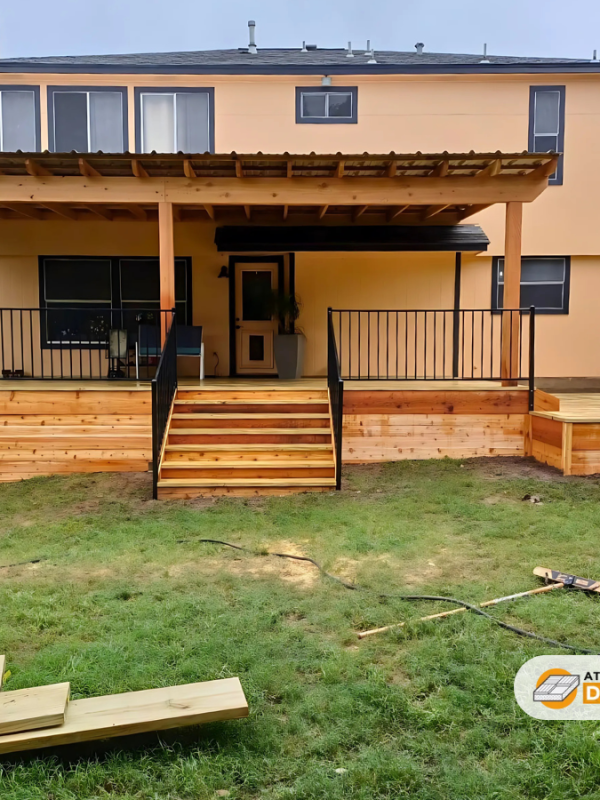
Second-chapter decks get designed differently than starter decks, because they’re built from knowledge the first deck earned. You already know where the summer sun makes the old spot unusable at dinner, which corner the traffic actually crosses, and what the household’s real gathering size is. We design from those facts: shade planned for the hour you’ll use it, wood decks or composite chosen against your genuine appetite for upkeep, and room sized for the birthdays you actually host. That’s the real difference between first and second decks: the first one guessed, and the second one knows.
Materials split about evenly in Cedar Park and we have no side: wood for feel, budget and shaded yards, composite for the full-sun lots and full-calendar households. The existing deck usually casts a useful vote, since how the original weathered tells us exactly what your exposure does to a finish. Bring its history to the estimate and it’ll earn its keep one last time. The old deck’s weathering is a decade of exposure data nobody had to pay for, and reading it correctly is half the material decision. Bring photos of it if the teardown already happened; even those still testify.
Newer Cedar Park homes also come with covered patios more often than older stock, and the best second-chapter designs treat that cover as the anchor: the deck extends the covered zone outward, shade transitions get planned rather than improvised, and the indoor-outdoor line from kitchen to rail becomes one continuous room. It’s a layout advantage the starter deck never used, and it’s usually the first thing our sketch exploits.
Keeping the New One New
The care cycle comes standard here like everywhere we work: deck staining on the schedule your exposure sets for wood builds, periodic hardware and structure checks for everything, and a deck inspection when a deck reaches the age where guessing stops being comfortable. Cedar Park’s first-generation decks mostly missed out on that kind of attention, which is half of why they aged the way they did. The second generation doesn’t have to. A first-generation deck that skipped its decade of care is the cautionary tale; the second one, on a schedule, is the counterexample, and the difference shows by year five.
HOA review boards are part of the rhythm in most Cedar Park neighborhoods, and we work with them the same calm way: scope paperwork that answers their questions, design constraints folded in early, timelines that include the approval window. Where city permits apply, our trusted third-party partners handle the process. Both processes run in parallel with design, so the calendar loses nothing to the paperwork.
We also photograph and document the original deck before it goes, partly for the before-and-after satisfaction, mostly because the old structure’s wear patterns are data: where it grayed fastest is your sun map, where it stayed damp is your drainage map, and the new design reads both. Nothing about the starter deck’s decade of service gets wasted.
Already in the Neighborhood
Cedar Park sits squarely inside our weekly working map, between Round Rock jobs to the east and the hills west of Austin, so visits book fast and follow-up doesn’t wait on a special trip. A crew that’s already nearby is the difference between a maintenance schedule that happens and one that was a nice idea. It’s also why Cedar Park maintenance schedules actually hold: the truck’s already passing on the way to somewhere, so the two-year staining visit happens in year two instead of whenever.
The proof, as always, is in the work: recent deck projects carries Cedar Park upgrades alongside everything else, and the before-and-after gap on a starter-deck replacement is the most satisfying spread in the album. Outgrown to outstanding is the whole arc, and it photographs beautifully.

Frequently Asked Questions
Can deck builders in Cedar Park expand my existing deck?
Often, and it’s the first thing we assess honestly: the original frame’s condition and footings decide whether an expansion builds on it or beside it. Some starter decks take an addition gracefully; many were built to a minimum that shouldn’t carry more. You get the structural read, then the versions priced side by side.
Is there really rock under Cedar Park yards?
Frequently, and shallower than people expect: the Hill Country limestone starts asserting itself here. It can mean tougher digging or, sometimes, anchoring to stone that will never move. Either way it’s a site fact the estimate visit checks, and one more reason a photo quote would be a guess.
Should I replace my builder-grade deck or upgrade it?
Let the frame vote first. A sound original can anchor an expansion; a minimum-spec one usually argues for starting fresh with a design built from what you learned living on it. The math includes what each path costs across a decade, not just this year, and the decision stays yours.
Do you handle Cedar Park HOA requirements?
Routinely. Most neighborhoods here review exterior projects, and the written scope gives boards what they ask for while the timeline absorbs the approval window. Flag the HOA at booking and the paperwork rhythm runs in the background while the design work moves forward. No board has ever been the reason a project stalled.
How quickly can you visit Cedar Park?
Fast, because we’re already working the area most weeks between builds, staining routes and repairs. Estimate visits book on normal scheduling rather than waiting for a trip out, and storm-damage checks jump the line after weather. Call during business hours and leave with a real date.
What do Cedar Park decks need that others don't?
Respect for what’s underground: limestone that changes footing work, and on some lots real grade that rewards multi-level thinking. Above ground it’s the same Texas sun as everywhere, setting finish schedules by exposure. The city’s specific mix of new homes and rocky ground is the local homework, and it’s done.
Closing
If the starter deck’s chapter is over, the good part starts with one visit. Reach our team or call 512-900-6030 and let’s design the deck the house deserved.
