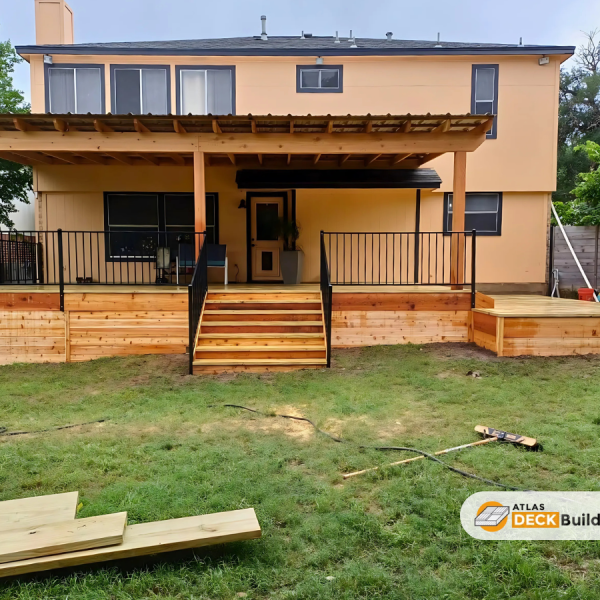
Wood Decks Built and Installed in Austin
Wood deck installation in Austin comes down to two honest choices: the right species for your budget and exposure, and a build that accounts for Texas weather. We handle both, and we tell you the finish schedule before you commit, not after.
Request Free Quote


Why Wood Still Wins Yards
Wood earns its place the old-fashioned way. It costs less up front than any alternative worth building with, it feels like nothing else underfoot on a summer evening, and when the surface finally ages, it refinishes rather than requiring replacement. A wood deck that’s looked after is a decades-long relationship, not a purchase. Request a wood deck estimate, and we’ll talk through whether that relationship fits how you want to live with your yard.
The honest half of the pitch: wood asks for something back. Texas sun is the hardest thing a finish faces anywhere in this country, and a wood deck here needs staining on a real schedule, not a good intention. We build wood decks for people who hear that and nod, and we steer the others toward materials that better suit their patience. Nobody’s happy when the material and the owner are mismatched, least of all the deck.
Wood also suits the owner who likes a deck that is part of the household. It takes a hook for the string lights without a special fastener, forgives the dropped cast iron, sands out the skateboard experiment, and wears its years as character instead of damage. Materials that age gracefully ask to be lived on, and wood’s been passing that test on Texas porches for as long as there have been Texas porches.
The Woods That Work Here
Pressure-treated pine is the workhorse, and there’s no shame in it. It handles ground contact and framing duties on nearly every deck we build, regardless of the surface choice, and as a decking surface, it’s the budget’s best friend: strong, widely available, and ready to take stain well once it’s dried to the right moisture level. Its trade is appearance out of the gate and a little more movement as it seasons, both of which good building and good finishing manage. Grade matters within the species too, and the scope names the grade, because ‘treated pine’ covers a range and you deserve to know where in it your deck lives.
Cedar is the step up people can feel. Naturally resistant to decay and insects, lighter underfoot, better-looking from day one and friendlier to bare feet in the heat. It costs more, it’s softer, and it still wants its finish schedule respected, but a cedar surface on a treated frame is the classic Austin combination for a reason: each wood doing the job it’s best at.
Tropical hardwoods come up in research, and we’ll talk about them straight: they’re beautiful, extremely durable and meaningfully more expensive in both material and labor, and their density changes how everything from fastening to finishing works. For most projects, the money does more good elsewhere in the build, and we’ll say so, but if the look is the point, we’ll build it right.


Details That Decide a Wood Deck's Life
Wood rewards the builder who respects how it moves. Boards go down with gapping set to their moisture content and the season, because pine installed wet in March behaves differently from dry stock in September, and the deck has to be right in both cases. Fasteners are chosen for treated lumber’s chemistry, which corrodes cheap hardware years early. Joist tops get protected where boards trap water against them, because that hidden line is where wood decks quietly start to fail.
Cut ends get sealed as we go, since every cut reopens the door treatment closed. Board crowns get read and laid the right way up. None of this shows in a finished photo, and every bit of it is the difference between a wood deck that’s tired at year eight and one that’s just hitting its stride. It’s the standard our own deck installation work runs on, and wood gets the fussiest version of it.
And because wood’s future includes maintenance by design, we build with the maintenance in mind: board spacing that drains, rail details that don’t trap water, and surfaces a roller and brush can actually reach. A wood deck built by someone thinking about its tenth year is simply a different product than one built for the photo on delivery day. It’s why our wood builds don’t dread their maintenance visits; they were designed to make them quick.
The Finish Schedule, Up Front
Here’s the conversation most builders save for never: your new wood deck will need to dry before it can be finished, then it will need deck staining on an interval your sun exposure sets, roughly every two to three years for exposed decks and longer for shaded ones. We put that schedule in writing with the build scope, because a wood deck sold without its maintenance schedule is a surprise sold on delay. That’s not a sales tactic. It’s the difference between selling a deck and selling a deck’s whole life, and we only do the second kind.
The good news is that the schedule is the whole cost of admission. A wood deck that gets its staining on time, plus an occasional deck inspection as it ages, doesn’t just survive here. It looks better at year fifteen than most unmaintained decks look at five, and its problems stay small because someone’s regularly looking. We’re the same crew for all of it, which is the point.
Some owners handle their own staining, and we’re genuinely fine with that: the scope tells you the products and the interval, and the deck doesn’t care whose roller it was. What matters is that the schedule happens. For everyone else, our calendar does the remembering, which is the single biggest predictor of how a wood deck looks a decade in.
Wood, or Something Else Honest
If the staining schedule made you wince, that’s information worth having now. Composite decking trades higher upfront cost for a life without finish work, and for heavy-sun yards and busy owners it’s often the right call. We build both and have no side in the fight; the right answer lives in your shade, your budget, and your honesty about weekends.
What we won’t do is let a preference go unexamined. Plenty of people who came to us certain about composite left with cedar after standing on both, and the reverse happens weekly. The estimate visit is where the materials meet your actual yard, and if a deck repair on your existing wood deck would buy you five years to decide, we’ll tell you that too.
We build wood decks across Austin and out to Lakeway, where cedar against limestone hills looks like it grew there.
Browse recent deck projects, and you’ll see both materials aging in the same sun. The wood ones are the builds that photograph better every year they’re maintained, which is the quiet argument this whole page has been making.

Frequently Asked Questions
How long does a wood deck last in Austin?
Maintained, decades: the frame outlasts everything if it was built right, and the surface refinishes on schedule instead of wearing out. Unmaintained, the Texas sun starts winning visibly by year five. The variable isn’t the wood; it’s the owner’s follow-through, and we tell you the real schedule before you buy.
Which is better for a deck, cedar or pressure-treated pine?
Cedar wins on looks, feel, and natural resistance; treated pine wins on price and toughness. The classic answer is both: a treated frame doing the structural work with a cedar surface where hands and feet live. Budget decides more than ideology here, and we’ll price the combinations for your actual deck.
How soon can a new wood deck be stained?
When the wood says so, not the calendar. New treated lumber retains moisture and typically needs weeks to months to accept a finish properly, depending on the season and stock. We test boards rather than guess dates, and staining too early wastes the coat. The build scope includes the expected window for your deck.
Does installing a wood deck in Austin require special hardware?
Yes, and it’s not optional. Treated lumber’s preservative chemistry corrodes standard hardware early, so connectors and fasteners need the right coatings or stainless where exposure demands it. It’s a small line item that determines whether connections remain tight in year fifteen, and it’s built into every scope we write.
Will a wood deck splinter?
An unmaintained one eventually will, because UV breaks down surface fibers until they lift. A deck that gets its staining on schedule keeps those fibers sealed and stays kind to bare feet for decades. Species matters too: cedar stays friendlier longer than pine. The finish schedule is the real splinter prevention.
Can you build a wood deck over an old concrete patio?
Often, yes, and it’s a popular rescue for cracked or sinking patios. The condition of the concrete and drainage determine the framing approach, and height transitions at doors need to be thought through. It’s exactly the kind of site question the estimate visit answers properly, because the patio underneath is different at every house.
Closing
If real wood is calling, let’s find out what it takes in your yard. Reach our team or call 512-900-6030, and we’ll bring the straight answers.