
Pool Decks Designed and Installed in Austin
Pool deck installation in Austin answers three questions before anything else: how hot the surface runs barefoot, how it grips when wet, and where the water goes. We design wood and composite pool decks around all three, then make them beautiful.
Request Free Quote


Where Bare Feet Set the Rules
A pool deck is the most honestly judged surface we build. Nobody walks it in shoes, nobody uses it dry, and it faces more direct summer sun than any other structure in the yard. So the design brief writes itself: comfortable under bare feet in August, trustworthy under wet ones always, and built to shrug off the splash zone for decades. Request a pool deck estimate and we’ll start with how your family actually uses the water, because a lap-swimmer’s deck and a cannonball household’s deck are different builds.
The stakes are comfort, but they’re also the simple physics of wet feet moving fast. Every choice on this page, material, color, texture, drainage, board direction, either serves the barefoot sprinting eight-year-old or it doesn’t. We design for that kid, and everyone else turns out to be covered. Households with small kids get one extra design pass focused on sight lines from the house, because being able to see the water from the kitchen is a feature no material can add later.
Austin’s swim season earns the investment like few places do. Pools here run from April into October, which means the deck around one isn’t a summer accessory; it’s a seven-month living room. Surfaces that are merely tolerable get old fast across a season that long, and surfaces that are genuinely right get used every single evening of it.
Heat Is the First Material Test
Surface temperature decides more about a pool deck than any catalog admits, and color decides more about temperature than material does. Dark boards of any kind become griddles in direct Texas sun; lighter tones across both wood and composite stay usable through the afternoon the pool was built for. So the color conversation happens early and honestly, with sun-warmed samples underfoot at the estimate rather than swatches in the shade. It’s a five-minute test that has changed more material decisions than every catalog we’ve ever handed out.
Layout can beat the thermometer too. Shade structures positioned for the hottest hours, board runs that keep the main walking lines out of the worst exposure, and a towel-and-seating zone that gives feet somewhere kind to land all cost little at design time and pay off every July afternoon. The pool cools people down; the deck shouldn’t undo it on the walk over.
Shade earns its keep fastest poolside, and it wants engineering respect: anything overhead near water lives in wind and weather full-time, so sails, pergola-style structures and umbrellas all get anchoring designed for gusts, not just for gravity. Where a shade element is in the plan, its attachment points get built into the frame now, even if the shade itself comes next season.

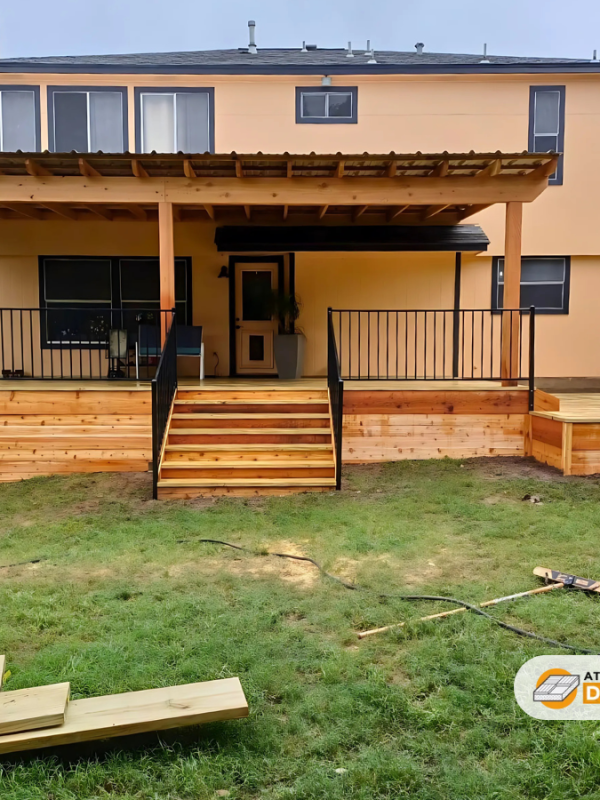
Grip, Splash and Where the Water Goes
Wet grip comes from texture, and texture is a real specification, not an accident. Composite lines vary meaningfully in wet traction, wood species and finishes have their own personalities when soaked, and everything gets judged by how it behaves in the splash zone, not the showroom. Board spacing and direction get set for drainage, so water sheds through and away instead of pooling where feet land. Fascia and skirting get the same wet-life treatment, because the splash zone doesn’t stop at the walking surface.
The water itself is a design load. Pool water carries sanitizer chemistry, splash is constant through the season, and the deck’s fasteners and hardware live in that mist, so corrosion-resistant hardware isn’t an upgrade poolside; it’s the baseline. Drainage under and around the deck gets planned so the constant moisture moves away from footings and the pool’s own structure, keeping the two neighbors on good terms for the long haul. We’d rather over-plan the drainage than ever explain a soft footing beside a pool, and that preference is built into every poolside scope we write, on every site, without exception.
The pool’s edge is its own detail: how the deck meets coping, how expansion is handled where structures move differently, and how access panels reach equipment without disassembling anything. These junctions are where pool decks succeed quietly or fail visibly, and they get drawn before they get built.
Wood and Composite, Poolside
Composite decking is the poolside favorite for honest reasons: it doesn’t mind constant water, never needs refinishing in the middle of swim season, and skips splinters entirely, which matters where every foot is bare. Its heat behavior is the one caveat, managed with lighter colors and the layout thinking above, and its wet-grip texture gets chosen deliberately by line. Poolside is where composite’s whole value proposition swims to the surface, and it’s the setting where we recommend it most often.
Wood decks bring warmth and a friendlier surface temperature, and they absolutely work poolside with the right species and a finish schedule that respects the splash zone’s pace: expect the wet zones to want deck staining attention on the shorter end of any interval. For households set on wood’s feel, that’s a fair trade made knowingly, and we’ll build it to make the trade as good as it can be. Species choice leans toward the naturally water-tolerant end of the menu poolside, and the scope says which and why.
Mixing materials is common and smart poolside: composite in the splash zone doing the wet work, wood on the dining level doing the charm. The estimate visit is where the combinations get priced against your actual pool and yard, and if an existing pool deck brought you here, our deck repair side will tell you honestly whether it’s a fix, a resurface or a restart.
The Deck the Pool Deserved
Plenty of Austin pools came with a concrete apron and a promise somebody forgot, and turning that into a real outdoor room is some of the most satisfying work we do: the pool stops being a feature in the yard and becomes the center of one. Elevation changes around sloped pool sites get the same level-by-level treatment as our hillside work, and the whole build runs on the discipline the deck installation hub describes, tuned for the wettest job site in the yard.
Evening swims deserve a line in the design too. Lighting conduit runs before boards close anything up, switch locations get decided while they’re cheap, and step edges get the illumination that wet feet at night genuinely need. It’s the kind of forethought that costs almost nothing during the build and can’t be added gracefully after it.
We build pool decks across Austin and out through Round Rock, where backyard pools anchor half the summer’s social calendar.
The poolside builds in recent deck projects are easy to spot: they’re the ones with wet footprints on them, which is the entire point of getting this surface right.

Frequently Asked Questions
What's the best material for a pool deck in Austin?
For most pools, lighter-colored composite with strong wet-grip texture: it ignores the water, skips splinters and never asks for refinishing mid-season. Wood competes on surface temperature and feel, paying for it with a shorter finish interval in the splash zone. Your family’s use pattern usually picks the winner.
How hot does a pool deck get in summer?
Color drives it more than material: dark surfaces of any kind become unwalkable in direct August sun, while lighter tones across wood and composite stay serviceable through the afternoon. We hand you sun-warmed samples at the estimate, because your feet should cast the deciding vote, not a brochure.
Is pool deck installation in Austin slippery-proof?
No surface honestly is, but wet traction is a real specification we choose for, not hope for. Textured composite lines and the right wood-and-finish pairings perform well soaked, board spacing sheds water instead of pooling it, and the splash zone gets the grippiest option in the plan. Design does the safety work.
Can you build a deck around an above-ground pool?
Yes, and it’s one of the best upgrades an above-ground pool can get: a surrounding deck at water height turns the pool into what reads as a built-in. The structure stays independent of the pool wall, access to equipment gets planned in, and the estimate visit sorts the layout for your specific pool.
Will pool water damage the deck?
Not when the deck was designed for it. Sanitizer-carrying splash is constant, so poolside builds get corrosion-resistant hardware as the baseline, drainage that moves water away from the structure, and materials chosen for wet life. A deck built to backyard specs beside a pool ages fast; a pool deck doesn’t.
Do you replace old concrete pool surrounds?
Regularly. Cracked or heat-radiating concrete aprons are the classic starting point, and a deck built over or beside them solves heat, comfort and looks in one project. The concrete’s condition and drainage decide the framing approach, which is exactly what the estimate visit assesses at your pool.
Closing
If your pool’s surrounded by concrete that could fry an egg, there’s a better version of that backyard. Reach our team or call 512-900-6030 and let’s design for bare feet.
